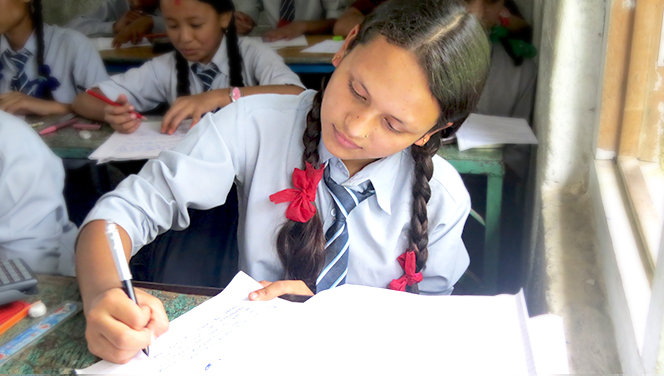
In today’s hyper-connected world, technology is a double-edged sword, especially for young minds. While it offers unprecedented access to information and learning tools, excessive and mindless use can take a toll on mental and physical health. Recognizing this critical need, the Rukmini Foundation, with the support of the G.L.O.W Club, organized a Digital Wellness Awareness Session at Shikharapur Community School on 22nd February 2026.
The session, facilitated by professional mental health counselor Sabina Baniya, saw the active participation of 85 students eager to understand their relationship with their devices.
Understanding the Challenge: More Than Just Screen Time
The program aimed to move beyond simply limiting screen time. The objective was to instill a concept of Digital Wellness—the idea of using technology mindfully and responsibly to enhance life, rather than distract from it.
During an interactive discussion, students reflected on their digital habits, and the results were revealing. While many leverage technology productively—using tools like ChatGPT and DeepSeek for assignments—a significant portion of their time is dominated by entertainment. Students admitted to spending an average of 3–4 hours daily on non-academic activities, with some reporting usage up to 12 hours a day. The most frequented apps? Gaming platforms like Free Fire and PUBG, and social media giants like TikTok, Instagram, and Facebook.

The Hidden Cost of Connectivity
The session delved into the tangible drawbacks of excessive screen time. Ms. Baniya facilitated an open conversation about the mental and physical health issues the students are already facing, including:
-
Mental Health: Anxiety, irritability, difficulty concentrating, loneliness, and the “Fear of Missing Out” (FOMO).
-
Physical Health: Eye strain, poor posture, sleep disturbances, and headaches.
Students bravely shared their personal struggles, speaking of feelings of isolation, jealousy when comparing themselves to others online, and even eating disorders. One student’s reflection question, “Do you feel anxious if you cannot check your phone?”, resonated deeply with many who admitted to feeling uneasy and irritated when disconnected.

From Awareness to Action: Practical Tools for Balance
Identifying the problem was only the first step. The core of the session was dedicated to providing students with practical strategies to regain control. Ms. Baniya guided them on how to set healthy boundaries, including:
-
Tech-Free Zones: Keeping devices away from the dining table and bedroom.
-
Digital Curfews: Disconnecting from screens one hour after waking up and one hour before bed to improve sleep hygiene.
-
Mindful Usage: Asking “Why am I picking up my phone?” before mindlessly scrolling.
-
Notification Management: Turning off non-essential alerts to reduce distractions.

Voices from the Session
The impact of the program was best reflected in the students’ feedback. Krish shared, “I usually look at my mobile phone when I feel bored and often experience eye strain. Today, I learned that playing outdoor games can help keep my body healthy. I also learned a new term, ‘Digital Wellness,’ and understood its importance.” Similarly, Nirbika noted, “I learned that the excessive habit of using mobile phones reduces our productivity and concentration. I now understand the importance of making a proper schedule.”

A Resounding Success
The session concluded on a high note, with overwhelmingly positive feedback. A remarkable 80% of students rated the program as ‘Excellent’ or ‘Very Good’ . This response underscores a growing appetite among young people for guidance on navigating the digital world safely and healthily.
The Digital Wellness Awareness Session was more than just a workshop; it was a wake-up call and a toolkit rolled into one. By fostering self-reflection and providing actionable strategies, we hope to empower these students to use technology not as a master, but as a tool for learning, connection, and personal growth.

- Sitting in the Circle with Our Big Sisters - March 28, 2026
- Cultivating Change: How Organic Farming at Kalika School is Helping Us Empower Girls - February 28, 2026
- Fostering Mental Resilience in the Digital Age - February 28, 2026
- Cultivating Resilience: Why Mental Health Is the Root of Girls’ Empowerment - February 27, 2026
- Guiding Our Students Towards a Brighter Future - November 27, 2025