
While the certificates celebrated the completion of their coursework, the event was really about reinforcing a powerful message: You cannot empower a girl’s mind if you ignore her mental health.
The Role of Teachers in Shaping Safe Spaces
Our Executive Director, Ms. Usha Adhikari, opened the program with a metaphor that resonated deeply with everyone present. She reminded us that schools must be safe spaces where emotional well-being is nurtured, “much like caring for a garden.”
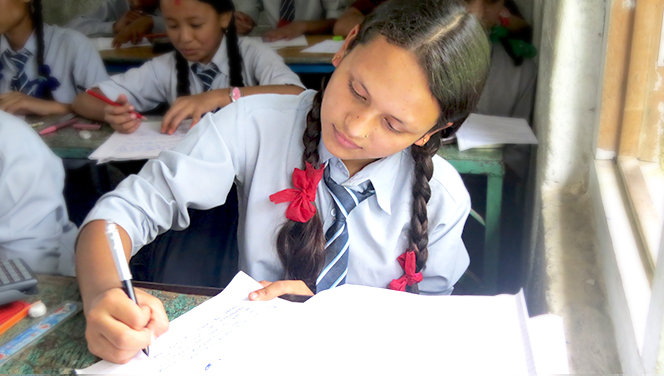
For the girls in our programs, school is often their primary sanctuary. However, as shared during the session by trainer Balkumari, students often arrive carrying invisible burdens—tiredness, hunger, stress from homework, peer conflicts, or feelings of humiliation. If a teacher is not trained to see these signs, a student in distress can easily be dismissed as “not working hard enough.”
This is why the Rukmini Foundation model focuses so heavily on the mentor. We train teachers to move beyond being mere instructors. We teach them to:
-
Listen actively to what students are saying (and not saying).
-
Engage through songs, games, and play to relieve stress.
-
Provide emotional support, creating an environment where children feel understood.
When a girl feels safe and understood, she develops an interest in learning. Her academic performance improves because her mind is no longer clouded by worry.

The Lasting Impact of a Teacher’s Words
During the experience-sharing segment, one of our speakers, Som Sir, highlighted a critical truth: “Teachers’ words leave a deep and lasting impact on children.”
For a girl navigating the complexities of adolescence in a rapidly changing world, a single careless comment can reinforce insecurity, while a few words of genuine encouragement can build unshakable confidence. By training teachers to manage their own stress and communicate with sensitivity, we are ensuring that every interaction they have with a female student is an opportunity to lift her up.
As the Chief Guest, Mr. Laxman Dahal, noted, “Simple actions, such as appreciating students appropriately, must be done with sensitivity.” Some students, particularly those facing societal or familial pressures, may feel insecure. A mentor who understands this nuance can tailor their support to build the student’s self-esteem rather than inadvertently diminishing it.

Building a Holistic Path to Empowerment
School leaders like Mr. Binod Mahat (Principal, Shikharapur) and Mr. Shyam K.C. (Chairperson, Shikharapur CLC) echoed the importance of this holistic approach. They emphasized that teachers must first manage their own stress to be effective mentors.
By investing in the mental health of educators, we are creating a ripple effect. A mentally healthy teacher fosters mentally healthy students. And mentally healthy girls—those who feel seen, heard, and valued—grow into the productive, confident, and resilient leaders of tomorrow.
At Rukmini Foundation, we don’t just see education as a pathway out of poverty; we see it as a journey toward wholeness. Through initiatives like this Mental Health Training program, we are ensuring that the girls in our communities are supported not just academically, but emotionally, allowing them to bloom to their fullest potential.


- Sitting in the Circle with Our Big Sisters - March 28, 2026
- Cultivating Change: How Organic Farming at Kalika School is Helping Us Empower Girls - February 28, 2026
- Fostering Mental Resilience in the Digital Age - February 28, 2026
- Cultivating Resilience: Why Mental Health Is the Root of Girls’ Empowerment - February 27, 2026
- Guiding Our Students Towards a Brighter Future - November 27, 2025